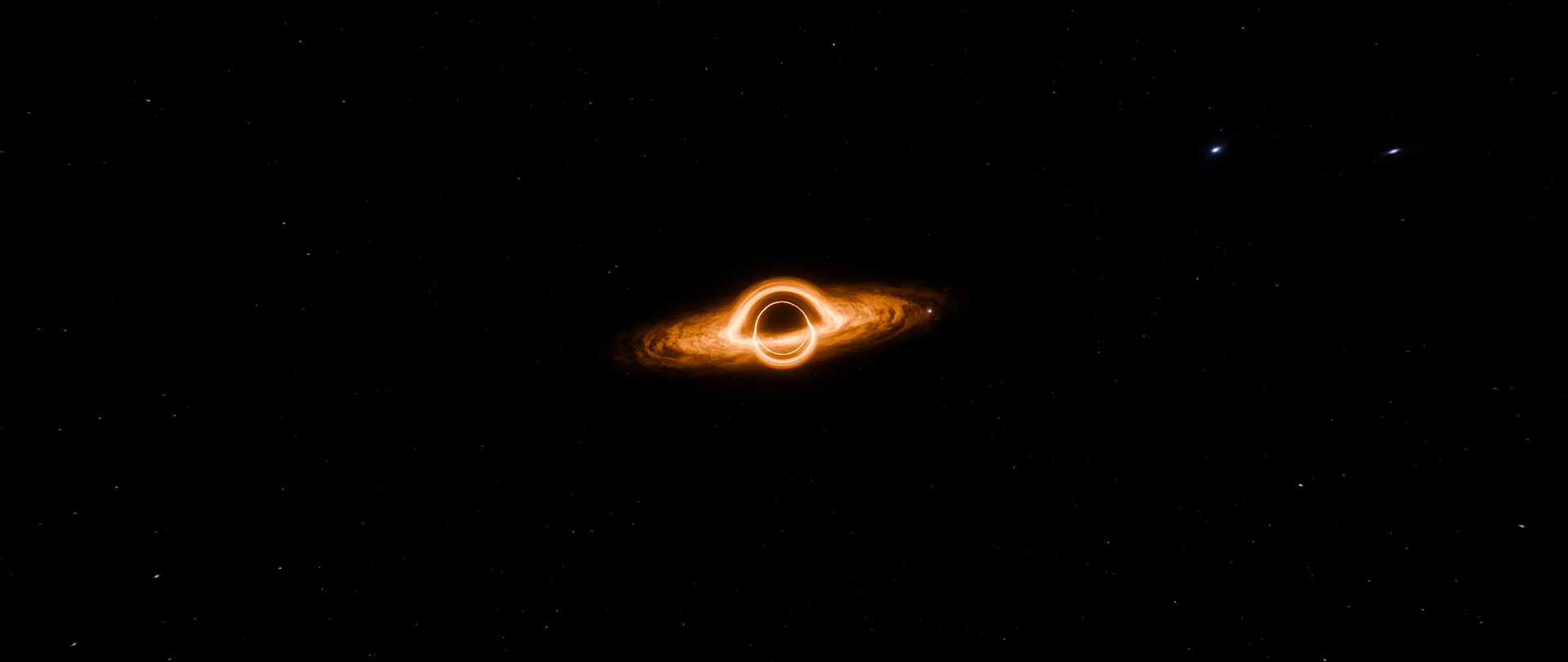
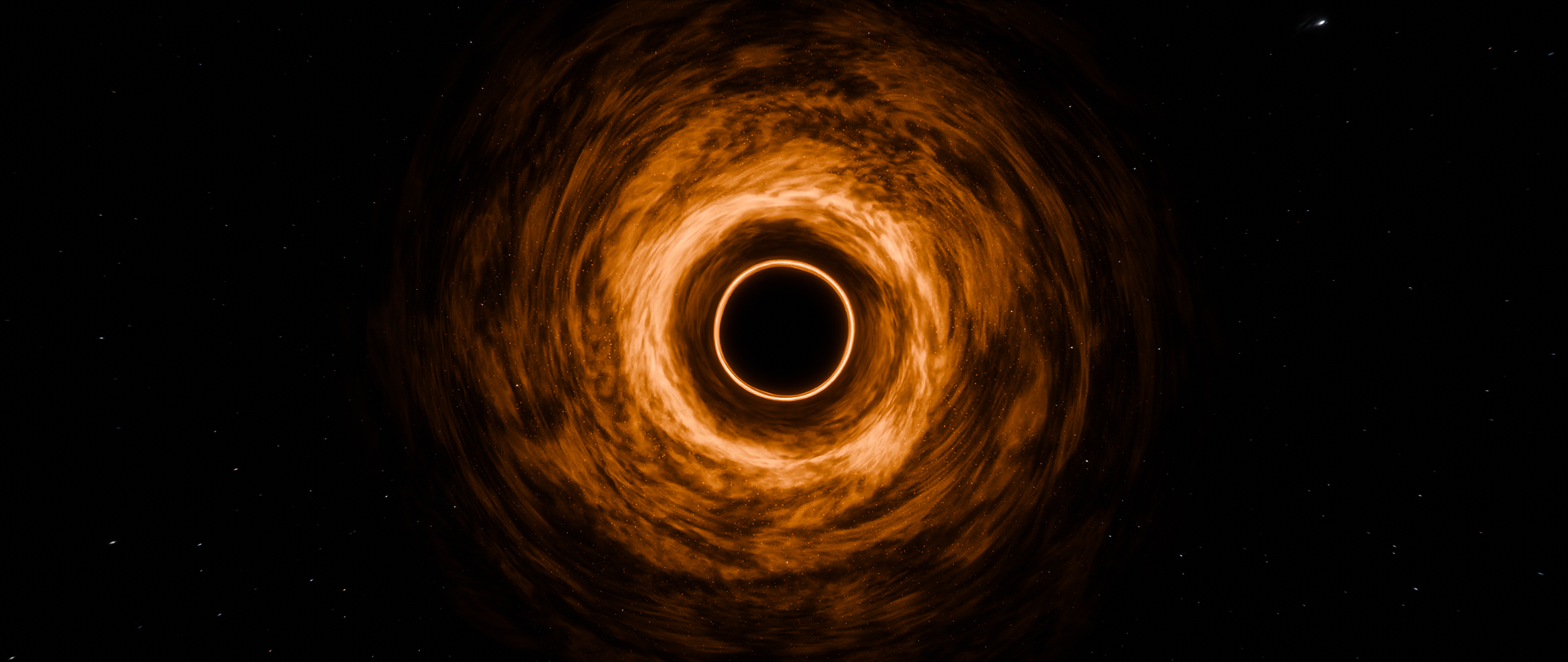
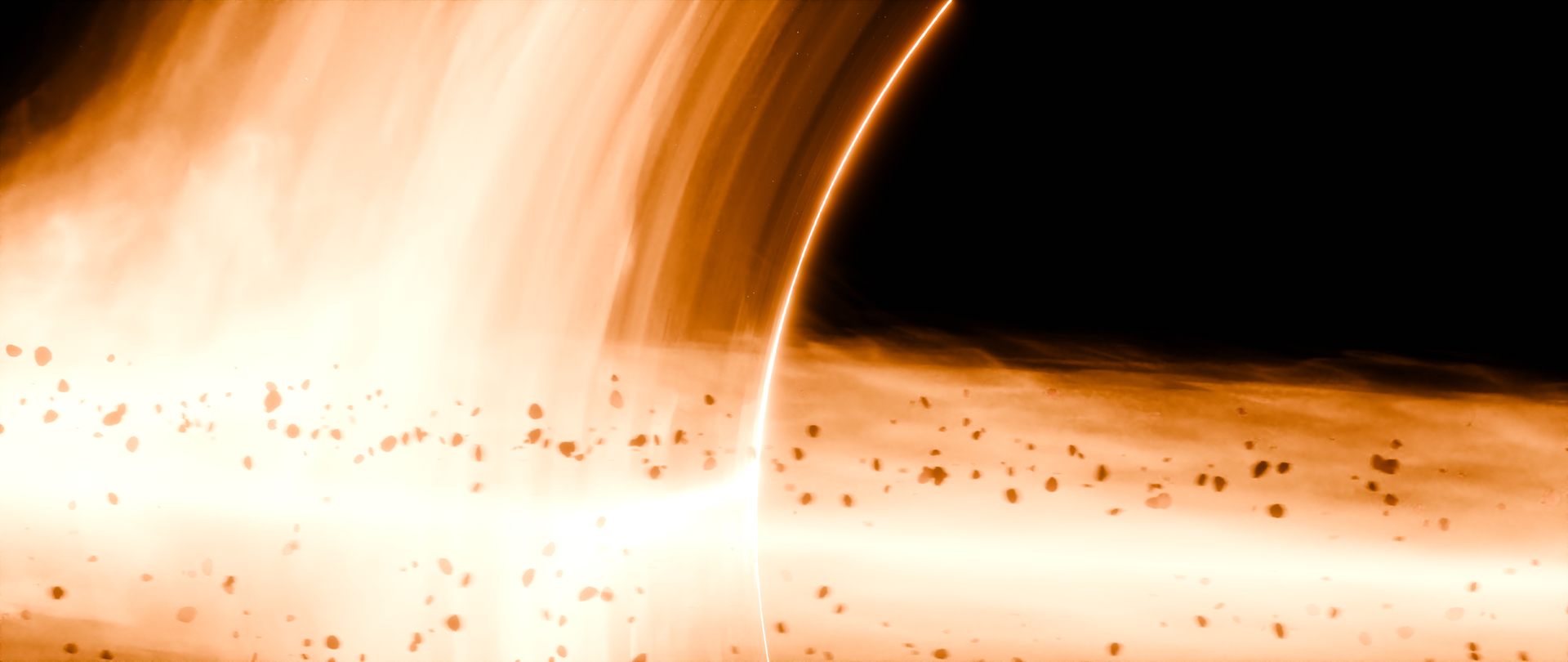
This project explores the challenge of representing a black hole in a way that feels both visually compelling and scientifically grounded. Unlike most subjects in 3D, a black hole cannot be approached as a traditional object. It has no surface, no direct visibility, and its defining characteristic is the distortion it causes to light and space itself.
The core challenge was translating an abstract astrophysical phenomenon into a readable visual language. This required studying gravitational lensing and understanding how light behaves near extreme mass. The solution was not to model a “black hole” directly, but to build a system that simulates how surrounding elements are warped, bent, and amplified from the viewer’s perspective.

A key part of the process was balancing scientific plausibility with clarity. Real-world representations of black holes can easily become visually confusing or underwhelming if interpreted too literally. The approach here was to simplify without losing credibility, exaggerating certain effects like the accretion disk glow and light distortion to guide the viewer’s eye and reinforce scale, while maintaining a structure consistent with known physics.
Another important consideration was accessibility. The piece was designed to work for viewers with no prior knowledge of the subject. This influenced decisions in composition, pacing, and framing. The black hole is introduced in isolation, without competing elements, allowing the audience to focus entirely on understanding its behavior. Camera movement and lighting were used intentionally to reveal the phenomenon progressively, rather than presenting it all at once.
From a technical standpoint, the project relied heavily on shader experimentation and compositing techniques to achieve the lensing effect. Since Blender does not natively simulate relativistic light bending, the distortion had to be approximated through custom setups, combining refraction, mapping distortion, and layered rendering passes.
The entire piece was developed in a single day, which imposed constraints that influenced prioritization. The focus remained on delivering a clear, believable visual rather than overextending into unnecessary detail. This constraint-driven approach helped reinforce decision-making around what truly contributes to the final image.
This project demonstrates an approach to visual storytelling that prioritizes interpretation over replication. The goal is not just to recreate a phenomenon, but to communicate it effectively through controlled visual design.
Frames